
When EV manufacturers, fleet operators, and consumers choose a battery for electric vehicles, they are making a decision that affects range, lifespan, safety, and total operating cost for the next several years. Increasingly, that decision lands on NMC — Nickel Manganese Cobalt — lithium-ion battery chemistry also widely known as NMC Battery Technolgy.
At Advantex Battery, NMC is our chemistry of choice for the electric two-wheeler and three-wheeler applications we serve in India. This post explains what NMC is, how it compares to the alternatives, and why it has become the dominant technology in the EV battery segment.
What Is an NMC Battery?
An NMC battery is a lithium-ion battery in which the cathode is made from a combination of Nickel (Ni), Manganese (Mn), and Cobalt (Co). The ratio of these three elements can be adjusted by the cell manufacturer to optimise for different properties — higher nickel content raises energy density, manganese improves structural stability and safety, and cobalt ensures consistent electrochemical performance.
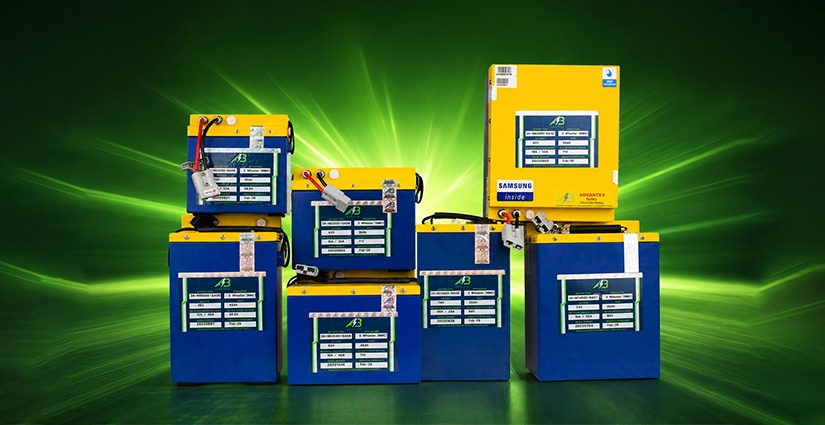
Common NMC ratios include NMC 532, NMC 622, and NMC 811, with NMC 811 (80% nickel) representing the high-energy-density end of the range. Advantex battery packs use Samsung NMC cells, which achieve a rated capacity of up to 5,300 mAh per cell — among the highest available from any tier-one manufacturer.
Why NMC Is Ideal for Electric Vehicles?
1. High energy density for extended range
NMC chemistry delivers energy densities of 200 to 250 Wh/kg at the cell level. This allows EV manufacturers to build battery packs that provide meaningful range without a proportional increase in weight or volume. For electric scooters, motorcycles, and e-rickshaws operating in Indian urban and semi-urban conditions, range per charge is one of the most important commercial considerations.
2. Long cycle life
Quality NMC cells are rated for 1,000 to 1,200 full charge-discharge cycles while maintaining acceptable capacity. For a two-wheeler ridden daily and charged every day, this translates to 3 to 5 years of useful battery life — several times longer than lead-acid alternatives and meaningfully better than many lower-grade lithium chemistries.
3. Strong power delivery
NMC cells offer excellent power density alongside their high energy density. This means the battery can deliver strong, consistent current during acceleration without significant voltage sag — an important characteristic for two- and three-wheelers that experience frequent stop-start riding patterns.
4. Thermal stability
Compared to earlier lithium chemistries such as LCO (Lithium Cobalt Oxide), NMC offers considerably better thermal stability. The manganese component helps stabilise the cathode structure at elevated temperatures, reducing the risk of thermal runaway under misuse or fault conditions. This is particularly relevant in India, where ambient temperatures regularly exceed 40°C during summer months.
5. Fast charging capability
NMC cells are well-suited to fast charging profiles. Their internal resistance characteristics allow them to accept high charge rates without excessive heat generation, enabling shorter charging windows — a major practical advantage for commercial EV operators managing fleet uptime.
6. Compact and lightweight design
An NMC battery pack is approximately 75% smaller in volume and 80% lighter than a lead-acid pack of the same usable energy. For two- and three-wheelers where every kilogram of battery weight affects handling, range, and load capacity, this is a direct performance benefit.
NMC vs Other Lithium-Ion Chemistries
NMC is not the only lithium-ion chemistry in use for EVs. Here is how it compares to the main alternatives:
NMC vs LFP (Lithium Iron Phosphate)
LFP offers excellent cycle life (often 2,000+ cycles) and very good thermal stability, but its energy density is lower — typically 90 to 160 Wh/kg at cell level. For a given battery volume, an NMC pack will deliver meaningfully more range. LFP is a strong choice where safety and longevity are prioritised above range, and is widely used in electric buses and stationary storage. For two-wheelers where weight and range per charge matter more, NMC generally offers a better balance.
NMC vs LCO (Lithium Cobalt Oxide)
LCO was widely used in consumer electronics but has fallen out of favour for EVs due to limited thermal stability and high cobalt content, which raises cost and creates supply chain concerns. NMC significantly outperforms LCO on safety, cycle life, and cost at equivalent energy densities.
NMC vs NCA (Nickel Cobalt Aluminium)
NCA, used notably by Tesla, offers high energy density comparable to or slightly exceeding NMC 811. However, NCA is more sensitive to overcharge and requires more sophisticated battery management. For most Indian EV applications, NMC offers a better combination of performance, manufacturability, and safety margin.
NMC Battery Demand in India
India’s EV two-wheeler market has grown rapidly, with over 10 lakh electric two-wheelers sold in FY 2024-25 and the segment continuing to expand. Government programmes including FAME II and the PM E-DRIVE scheme have accelerated adoption by subsidising EV purchase and supporting charging infrastructure development.
In this environment, the quality of the battery pack determines a vehicle’s actual cost of ownership far more than its sticker price. A low-cost pack that degrades in 18 months creates real economic harm to the operator or rider. A well-engineered NMC battery pack rated for 1,200 cycles, by contrast, delivers reliable performance across 3 to 5 years — which is the basis on which informed buyers are increasingly making their decisions.
Why Advantex Battery?
Advantex Battery as a top lithium battery manufacturer in India builds NMC battery packs specifically for electric two- and three-wheelers in India. Our manufacturing process follows a four-stage quality framework: 100% cell grading and sorting before assembly, 100% component testing, full batch traceability with recorded operator data for every step, and 100% finished pack testing against all electrical and safety parameters before dispatch.
Our packs incorporate smart BMS with app connectivity, multi-layer protection (overcharge, over-discharge, short circuit, thermal), fire-suppression cell coating, ingress protection, and fuse-based fail-safes — designed for Indian roads, Indian temperatures, and Indian usage patterns.
As one of Samsung’s approved battery manufacturing partners in India — a status that requires passing months of factory audits and quality evaluations — we integrate verified, high-grade NMC cells into every pack we produce.
Conclusion
NMC battery chemistry occupies a sweet spot that no other current lithium technology fully replicates: high energy density, strong cycle life, good thermal stability, and fast-charging capability, all in a compact, lightweight form factor. For electric two-wheelers and three-wheelers operating in Indian conditions, it is the most practical and commercially sensible choice available today.
Advantex Battery is an NMC battery manufacturer purpose-built for the Indian EV market. If you are an electric vehicle manufacturer, fleet operator, or dealer looking for a battery partner, we would be glad to talk.